Richard the Lionheart


- Medieval Era
- 4 mins
By Sir Windows
Richard I (8 September 1157 – 6 April 1199), more commonly known as Richard the Lionheart, was the second King of England from the House of Plantagenet, as well a Duke of Normandy, Gascony and Aquitaine. Born as the third of five sons to Henry II of England and Eleanor of Aquitaine, the young Richard wasn't expected to inherit his father's massive domain, which encompassed England along with most of western France. Richard spent his youth in the caring hands of archbishop Thomas Becket and his mother, receiving an education in Latin, music and poetry. In 1172 Richard received the Duchy of Aquitaine from his father. He then spent much of his adult life fighting rebellions in his own domain, or in turn fighting his father for his inheritance. By 1189 all of Richard's brother besides the youngest, John, had perished. Still Richard was weary of his father, who wished to bestow Aquitaine to John, Richard allied with the French King Philip II against his father. In the end, Henry II was forced to recognize Richard as the sole heir to his domains, passing away two days later. Richard was crowned King of England on 3 September 1189 in Westminster.
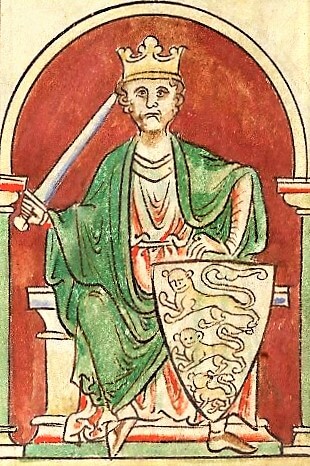
Richard I, 13th century manuscript, London, UK, British Library.
Following his ascension to the English throne, Richard focused all his efforts on preparing to go on a crusade, having taken the necessary vows in 1187 already. Richard managed to extract an enormous sum of money from his English subjects in preparation for his journey to the Holy Land. Richard found many creative ways to extract money from the English barons, ranging from lump sum payments upon marriage or inheritance to simply paying the king in order to be freed from an obligation to go on a crusade. Richard's previously cordial relationship with Philip II of France had since cooled off, as the English king went back on an agreement to wed Philip II's sister Alice in favour of Berengaria of Navarre. Both kings viewed each other with suspicion, yet both monarch departed for the crusade on the same day in 1190. On his way to the Holy Land, Richard was involved in multiple adventures such as settling an inheritance crisis in the Kingdom of Sicily and conquering Cyprus from a Byzantine pretender. Finally, on the 8 June 1191 Richard arrived in the Holy Land and joined the Siege of Acre. The city had withstood a siege for two years already, but capitulated five weeks after Richard's arrival.
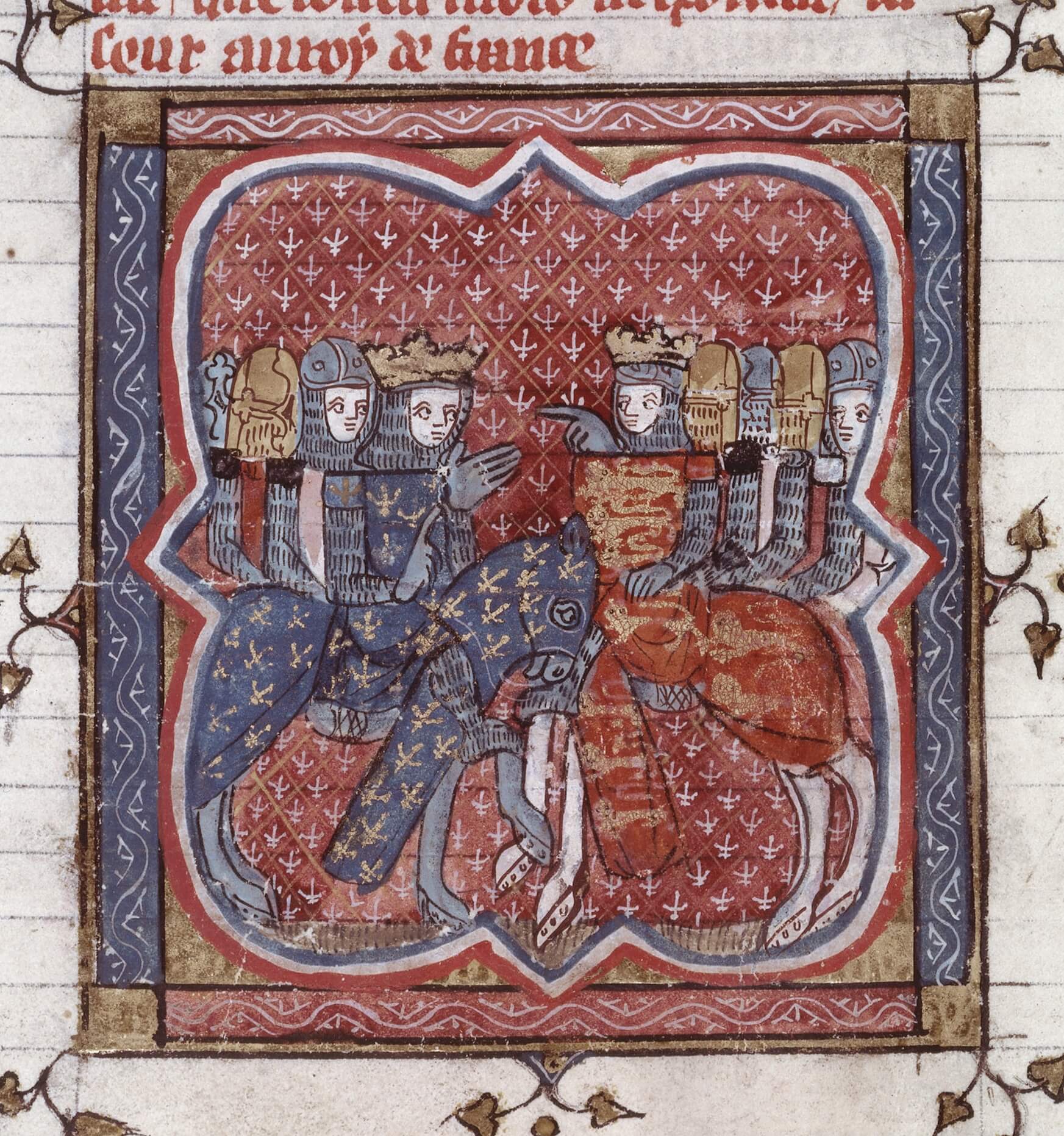
Richard I & Philip II, 14th century manuscript, Paris, France, Bibliothèque nationale de France.
Although the capture of Acre was a great triumph for the crusaders, it marked a notable split within the Christian alliance. Richard had deliberately or accidentally insulted the honour of Duke Leopold of Austria, which led to the duke's departure back home. Philip II of France also departed for his homeland soon after, stating health issues as a reason. Though more likely, his relationship with Richard had become unbearable for both sides. At any rate, Richard became overall commander of the remaining crusader forces and continued the fight. It is at this time that the great rivalry between Richard and Saladin developed. Until the middle of 1192 both Richard and Saladin campaigned against one another, with the English king scoring multiple victories over his opponent, marching his armies to Jerusalem twice. Eventually, sickness, limited resources and troubles back in France forced Richard to negotiate with Saladin. Both sides agreed to an armistice, followed by a treaty which gained the crusaders the coastal cities between Jaffa and Tyre. In the end, Richard and the crusade failed to regain Jerusalem, which remained firmly under Saladin's control, and the king set off for England in October 1192. He would not reach the island until 1194 though, as Richard would endure prolonged imprisonment by Leopold of Austria as revenge for insults suffered at Acre. After his release and return to England, Richard spent the remainder of his life defending his continental territories from the French. Richard fell in battle, mortally wounded by a crossbow bolt, in 1199 during the siege of the castle Châlus-Chabrol in Aquitaine.
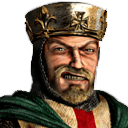
Richard as seen in Stronghold Crusader
Richard is one of the few historical characters prominently featured in the Stronghold series. Appearing in both Stronghold Crusader and Stronghold Crusader 2. His depiction in both games is influenced by the romanticized image of the king crafted during his lifetime and beyond as a true Christian knight and soldier. Just as he was in real life, Richard is an aggressive commander who prefers to strike first and hard rather than waiting for his enemy to come to him. His preferred unit in both games is the swordsmen, a stout and noble warrior, much like the king he serves. Richard also focuses on religion in both games, a fitting choice for one of the most famous crusaders. Richard is depicted as a very English character in both games, while in reality he most likely understood English, he spent only a total of six months in England as king and was predominantly a French and Occitan speaker. Aside from being famous for his crusading, Richard is also closely associated with the legends of Robin Hood, a yeoman turned outlaw in defense of King Richard. SHC and SHC2 reference this by making archers and rangers the preferred ranged units of the Lionheart.

Richard as seen in Stronghold Crusader 2